

DTG Printer
Description:
Direct-to-Garment (DTG) is a digital ink-jet printing technology that applies water-based inks directly onto textile surfaces—primarily cotton fabrics. The core device is a dedicated white-ink printer, which must work together with auxiliary equipment (e.g., white-ink circulation shaker) to maintain ink stability
-
![Digital Sock Printing Machine]() Digital Sock Printing MachineThe New Mosheng Y450 Digital Sock Printing Machine is engineered for entrepreneurs and established brands who demand high-quality, 360-degree seamless printing on socks, sleeves, and wristbands....read more
Digital Sock Printing MachineThe New Mosheng Y450 Digital Sock Printing Machine is engineered for entrepreneurs and established brands who demand high-quality, 360-degree seamless printing on socks, sleeves, and wristbands....read more -
![Direct To Garment Printer]() Direct To Garment PrinterThe SG-4050mini DTG Printer is a machine that can directly print on fabrics.widely applied in the fashion industry Key Features Compact Design : Miniaturized industrial footprint for flexible...read more
Direct To Garment PrinterThe SG-4050mini DTG Printer is a machine that can directly print on fabrics.widely applied in the fashion industry Key Features Compact Design : Miniaturized industrial footprint for flexible...read more -
![Dtg Printing Machine]() Dtg Printing MachineThe SG-5060 Plus DTG printer excels in combining speed , adaptability , and professional-grade output for textile-centric businesses. Core Specifications: Print Heads : Dual industrial-grade...read more
Dtg Printing MachineThe SG-5060 Plus DTG printer excels in combining speed , adaptability , and professional-grade output for textile-centric businesses. Core Specifications: Print Heads : Dual industrial-grade...read more -
![Print To Garment Printer]() Print To Garment PrinterProduct model:destop DTG printer: DTG3040 Print head:Epson il080 Number of print heads:1 Max print size:i 30 X 42 cm Inktype:DTG-10link A variety of customization solutions DTG printers utilize...read more
Print To Garment PrinterProduct model:destop DTG printer: DTG3040 Print head:Epson il080 Number of print heads:1 Max print size:i 30 X 42 cm Inktype:DTG-10link A variety of customization solutions DTG printers utilize...read more


Workflow
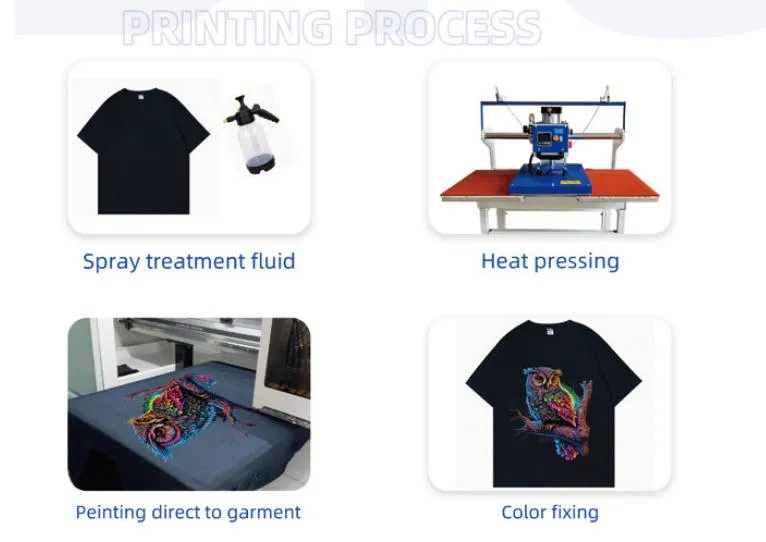
Pre-treatment → Heat press → Direct printing → Color fixation
Spray pre-treatment fluid
Use a spray bottle or an automatic pre-treatment machine to evenly coat the area to be printed with an aqueous pre-treatment solution. This “opens” the cotton fibers, helping white and color inks adhere better and preventing ink bleeding.
Heat pressing (drying)
Place the pre-treated fabric under a heat press at approximately 160 °C for 10–15 seconds. This evaporates the moisture, flattens the fabric, and removes lint to create a smooth, dry “printing bed.”
Printing direct to garment
Secure the garment on the printer’s platen. The machine first jets white ink as an under-base (essential for dark garments), then prints the full design layer-by-layer via CMYK+ multi-color channels. The process is essentially replacing a sheet of “paper” with a T-shirt.
Color fixing (curing)
After printing, cure the ink with either a heat press or a tunnel dryer at 160–170 °C for 90–180 seconds. This cross-links ink molecules with the fibers, achieving wash- and rub-fastness. After curing, the garment is ready for normal washing and wearing.
Technical Features
1.Direct jetting—no transfer required. Printheads deliver water-based textile pigment inks straight into the garment fibers; heat-press curing is all that’s needed.
2.Ultra-high resolution & photo-realistic gradients.
3.No need for screens or plates; a single piece can be finished in 2–3 minutes—perfect for e-commerce “order today, ship tomorrow.”
4.Uses eco-friendly, water-based inks with low VOC emissions; printed areas remain breathable with no rubbery edges.
Applications
• Apparel customization: small-batch, personalized printing on cotton T-shirts, hoodies, canvas shoes, etc.
• Promotional gifts: corporate-event commemorative shirts, sports-event merchandise.
• Designer sampling: rapid prototyping to verify pattern effects.

why choose us
Competitive price
All the product pricings are updated monthly according to the market changes to make sure our customers get the most cost-effective machines.
One Stop Solution
From personalized customization to industrialized production, our company provides comprehensive, one-stop service support from investment planning, product design, machine installation and commissioning, daily maintenance, software upgrade services to spare parts supply according to the specific needs of various industries.
Quality assurance
Conducts rigorous quality inspections before shipment to ensure that all functions of the equipment are normal.
Zero inventory model
Agent partners can enjoy direct order shipping services, avoiding inventory overstock costs, and flexibly responding to market fluctuations.
Q&A
Q1: What fabrics can a DTG printer actually print on?
A: The safest choices are 100 % combed cotton or cotton blends with ≥ 80 % cotton. Polyester, nylon, or waterproof fabrics require plasma or polyester-specific pre-treatments. Fabrics with spandex (e.g., stretch hoodies) or long-pile terry towels are not recommended because they tend to lint or suffer color loss.
Q2: Will the white under-base on dark garments crack or peel?
A: As long as the three steps are executed correctly—sufficient pre-treatment → white ink under-base → heat press at 165 °C for 90–120 s—the wash-fastness remains ≥ Grade 4 after 30 home wash cycles at 40 °C. Peeling is usually caused by insufficient pre-treatment or incorrect curing temperature/time.
Q3: How often must the machine be maintained?
A:
• Before every startup: perform nozzle moisturizing + flash cleaning.
• After every 4–6 h of printing: run automatic wiper cleaning.
• Weekly: conduct a deep clean + white-ink circulation & stirring.
• Ideal environment: humidity 45–60 %, temperature 20–28 °C.
Q4: DTG vs. DTF—how do I choose?
• Primarily cotton, breathability required, single-piece custom jobs → choose DTG.
• Mixed fabrics (polyester, canvas, swimwear) or transfers onto bags/caps → choose DTF.
As one of the most professional dtg printer manufacturers and suppliers in China, we're featured by cheap products and good service. Please rest assured to buy discount dtg printer from our factory. For customized service, contact us now.
eco friendly printing machine, industrial inkjet printing machine for customized labels, inkjet printer with precise color output